Research
From simulations to a compact model
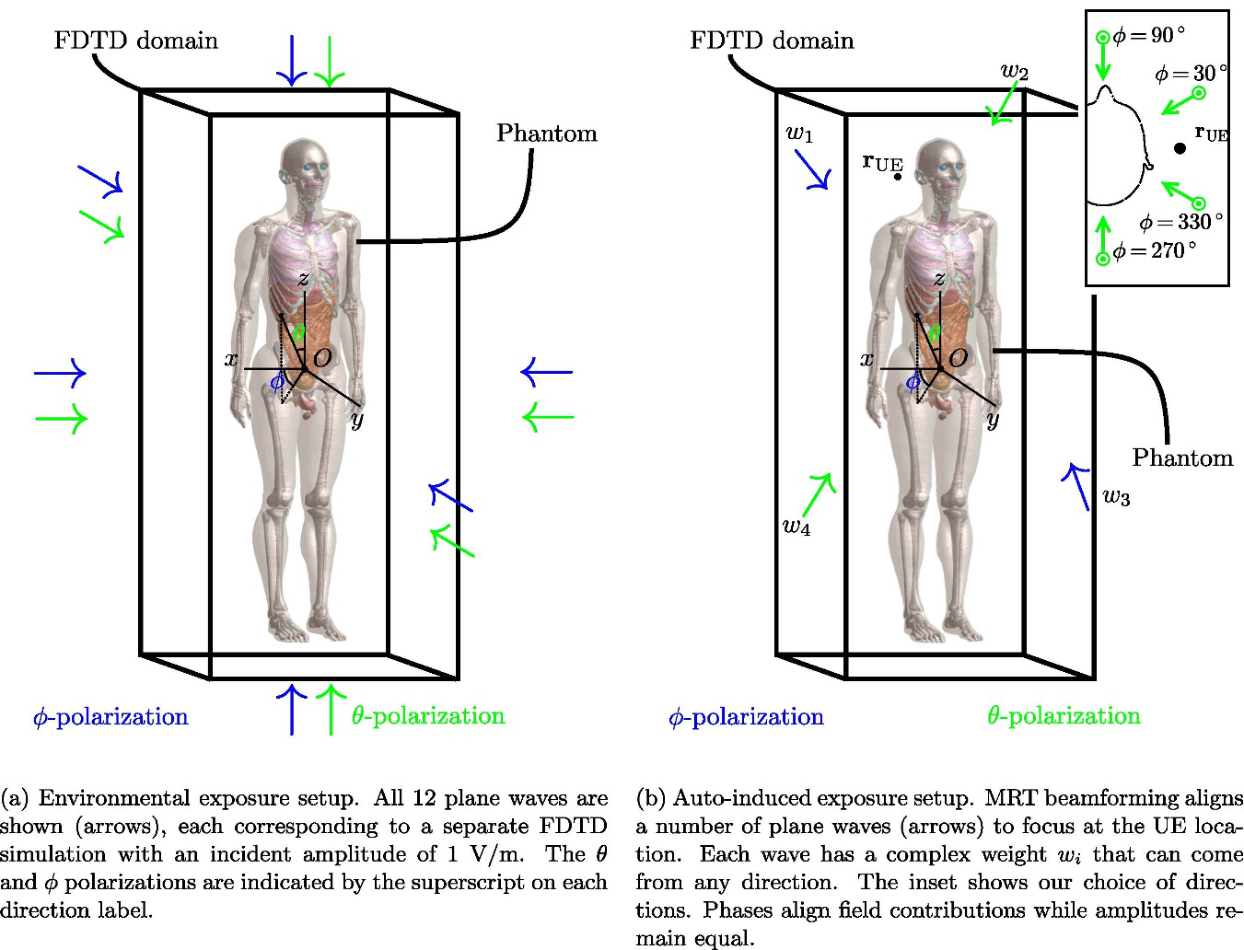
I ran a campaign of 550 FDTD simulations across two adult and two child body models, at 15 frequencies from 450 MHz to 26 GHz. The simulations compare environmental exposure with beamforming towards the person.
Patterns in these results led me to a compact model of how the body absorbs electromagnetic waves. I derived the model from Fresnel transmission and body geometry, and checked it against FDTD, analytical solutions and published measurements.
 View full size
Measurements and calibration
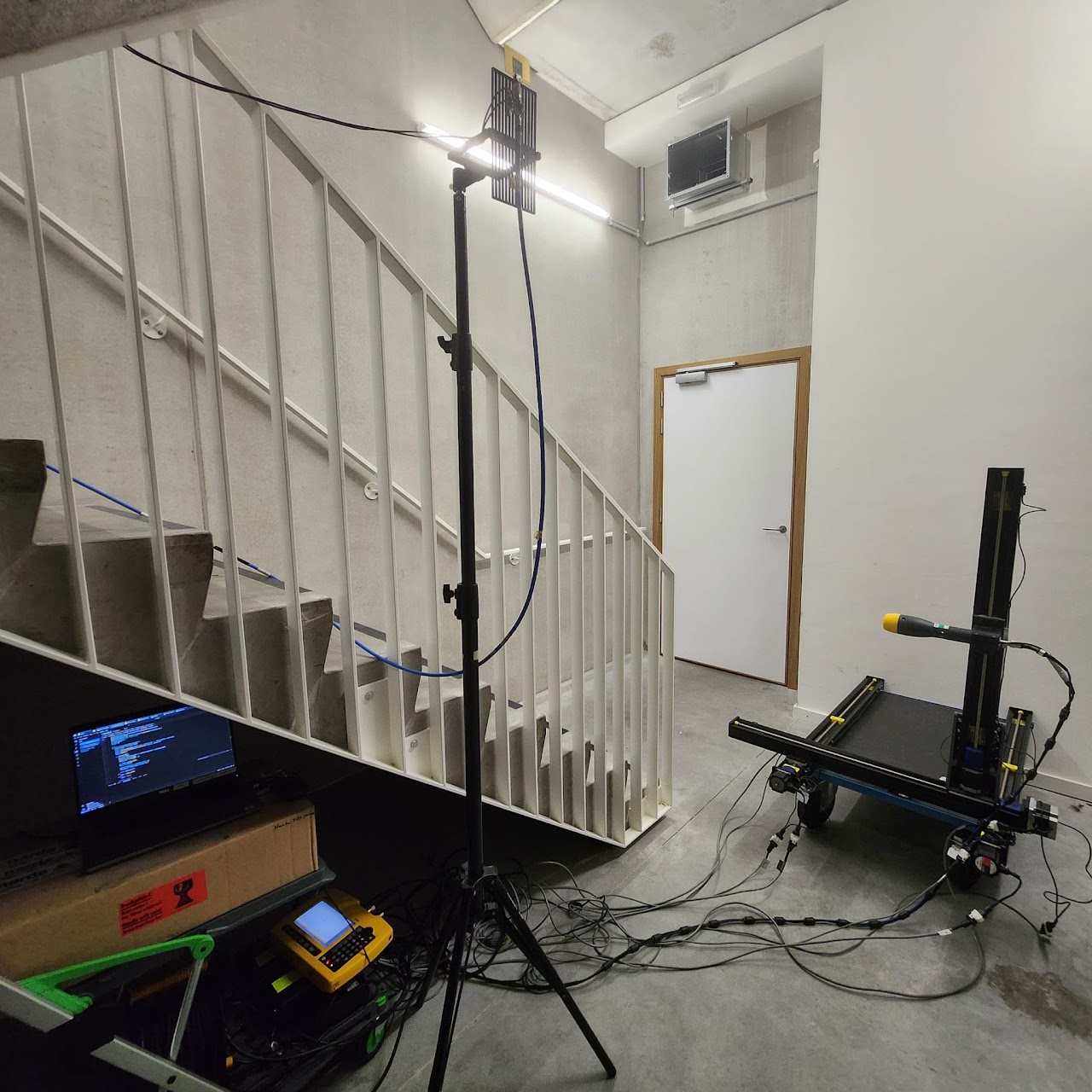
I designed and carried out robotic measurements of the electric field in a room at 28 GHz. I use these scans to calibrate the material properties, antenna position and measurement alignment in the simulation.
To check whether the model predicts measurements it has not seen, I hold out one measurement plane at a time and fit the model using the others.
Variation and uncertainty
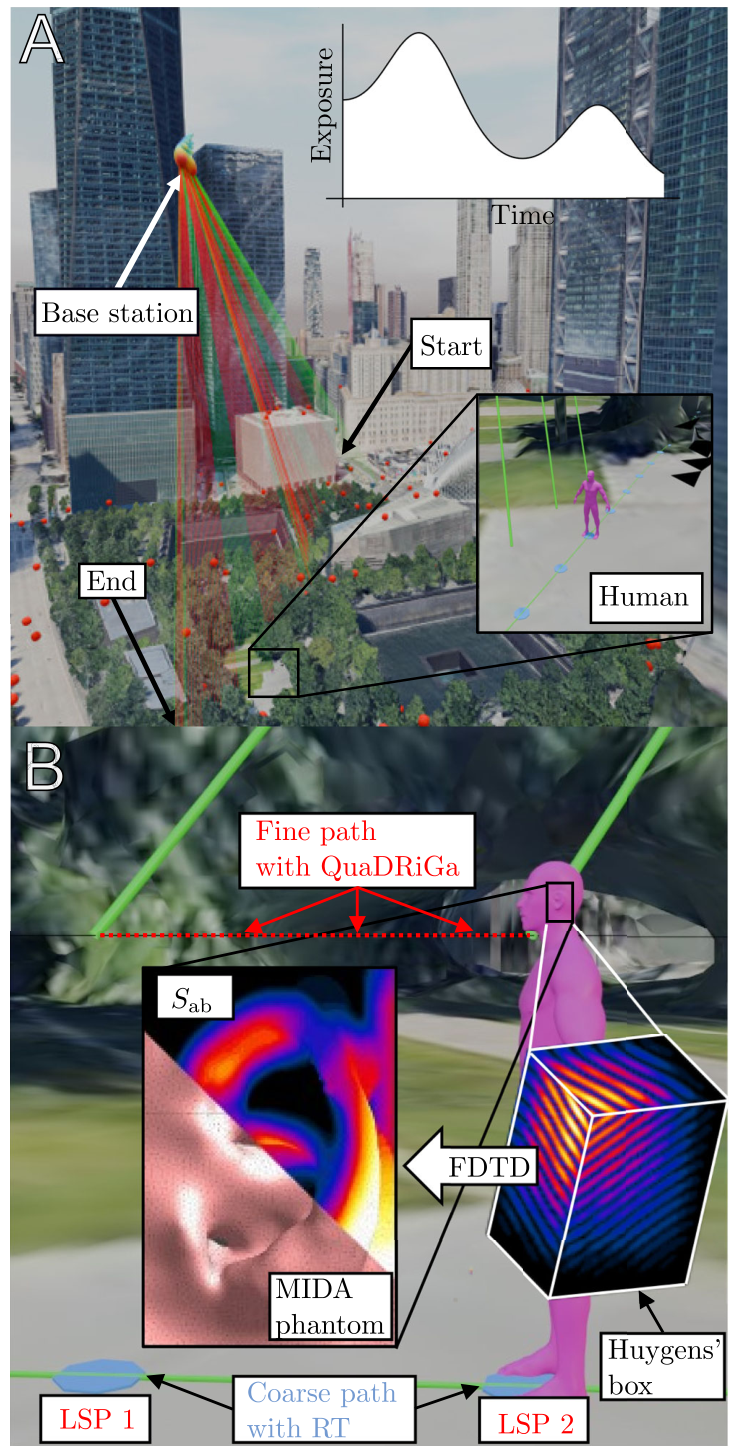
In my outdoor simulations, I combine ray tracing with QuaDRiGa to model the small-scale variation of the wireless channel along a walk. I then use FDTD to compute the fields inside the body.
In the ten-city study, I use repeated random ray samples to check numerical convergence, and compare material assignments while keeping the geometry and sampling fixed. For the compact model, I also examine how uncertainty in tissue properties affects the predicted absorption.
 View full size
Scientific software
Software detailsGOLIAT
I built GOLIAT to configure, run, analyse and report FDTD simulation campaigns in Sim4Life. It keeps the study settings with the results and handles the repeated setup and extraction work.
Research visit & awards
Affiliation
WAVES research group · imec & Ghent University
Research projects
My Ph.D. is funded in part by the following research projects. Check out their websites!
GOLIAT project: to improve the quality of epidimiological studies, I use computer simulations to quantify how fields are realistically absorbed in humans. Funded through the European Commission's Horizon program.
"SHAPE - next generation wireless networks" project: to know how 6G antenna systems impact the exposure on humans. Funded through Methusalem.
"ATTO - A new concept for ultra-high capacity wireless networks" project: to know how extremely performant systems in 'Factories of the Future' affect our exposure. Funded through the ERC.